MPLS VPN International Enterprise Network Layout: Regional Perspective??? Solution//Global IPLC service provider of Shigeng Communication
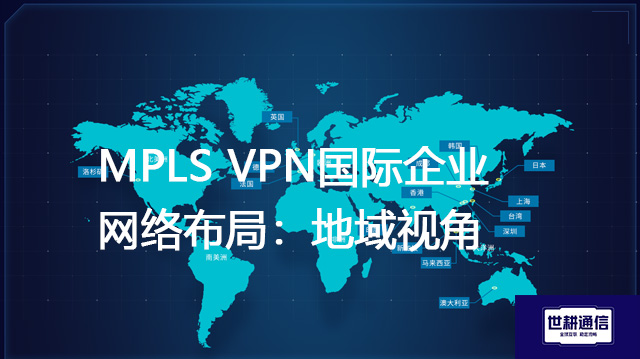
一、MPLS (Multi Protocol Label Switching) VPN technology, with its efficient, secure, and scalable features, has become the core solution for international enterprises to build global networks. From a regional perspective, its layout logic is deeply linked to the global regional economic pattern, digital infrastructure distribution, and enterprise globalization strategy, presenting a three-tier architecture feature of "core hub radiation, regional cluster linkage, and emerging market penetration", while balancing the three major elements of performance, cost, and compliance.
1. Core hub: high-density layout of the global network "aorta"
North America, Europe, and Asia Pacific (Singapore, Japan, Hong Kong, China) are the core regions of the global digital economy and the "primary hubs" of MPLS VPN networks. These regions are home to over 70% of multinational corporations' headquarters and data centers worldwide, with network demands characterized by high bandwidth, low latency, and multi business support. For example, the transatlantic link between New York, London, and Frankfurt, as well as the Asia Pacific circular link between Singapore, Tokyo, and Sydney, typically use dual 10 Gigabit MPLS backbone connections to carry critical businesses such as ERP, video conferencing, and cloud computing. Service providers deploy dense POP (access points) in such areas to support enterprises in achieving "last mile" redundant access, ensuring zero interruption in scenarios such as financial transactions and R&D collaboration that require high network stability.
2. Regional Cluster: Localization Adaptation Strategy for Emerging Markets
In growth markets such as Latin America (Sao Paulo, Mexico City), the Middle East (Dubai), and Africa (Johannesburg), MPLS deployment needs to address the challenges of uneven infrastructure and significant policy differences. Enterprises often adopt the "regional center+branch" model: with regional hubs (such as S ã o Paulo covering South America) as the core, they connect with local operators through MPLS and then extend to neighboring countries. For example, as a hub in the Middle East, Dubai's MPLS network needs to be compatible with the cross-border data flow regulations of the Arab League, while also addressing the issue of insufficient submarine cable coverage in some countries through satellite links or microwave backup. In the cost sensitive market, enterprises will adopt the "hybrid MPLS" strategy - the core business will follow the MPLS special line, and non critical traffic will be diverted through the Internet encryption tunnel to balance performance and budget.
3. Compliance and Geopolitics: The 'Invisible Boundaries' of Network Layout
The data sovereignty laws of various countries, such as the EU GDPR and China's Cybersecurity Law, directly affect the deployment of MPLS nodes. Enterprises need to set up local POP points near the data generation location to ensure that data is not exported or transmitted through compliant channels. For example, the factory data of multinational manufacturing enterprises in China needs to be connected to the global network through local MPLS nodes to avoid direct cross-border access; Russia requires localized storage of critical data, forcing enterprises to independently deploy MPLS edge nodes within its borders. In addition, geopolitical risks (such as the US China trade friction) drive companies to build "multi-path redundancy" and diversify risks through neutral nodes in Southeast Asia (such as Singapore and Kuala Lumpur), ensuring that policy changes in a single region do not affect global network connectivity.
4. Technological Evolution: From "Connectivity" to "Intelligent Scheduling"
With the integration of SD-WAN and MPLS, the international enterprise network layout is upgrading from static topology to dynamic optimization. For example, real-time monitoring of global MPLS link quality through SD-WAN controllers, automatic switching of video conferencing traffic to low latency paths, or temporary expansion of cloud application bandwidth during major promotions. This "software defined" flexibility enables enterprises to dynamically adjust resources based on regional business fluctuations (such as holiday peaks in the Asian market and adjustments to European daylight saving time) without changing their physical layout, improving network utilization by over 30%.
Conclusion
The international enterprise network layout driven by MPLS VPN is essentially a dual mapping of "geographic space" and "digital space". It needs to rely on the global backbone network to build efficient connections and deeply adapt to regional differences - from economic activity to legal boundaries, from infrastructure maturity to cultural time zone characteristics. In the future, with the further integration of 5G private networks, edge computing and MPLS, the network layout of multinational enterprises will become more "distributed intelligence". On the basis of ensuring security and compliance, it will achieve millisecond scheduling of global resources, and provide a digital base that is "insensitive but ubiquitous" for global operations.
二、Shigeng Communication Global Office Network Products:
The global office network product of Shigeng Communication is a high-quality product developed by the company for Chinese and foreign enterprise customers to access the application data transmission internet of overseas enterprises by making full use of its own network coverage and network management advantages.
Features of Global Application Network Products for Multinational Enterprises:
1. Quickly access global Internet cloud platform resources
2. Stable and low latency global cloud based video conferencing
3. Convenient and fast use of Internet resource sharing cloud platform (OA/ERP/cloud storage and other applications
Product tariff:
Global office network expenses | Monthly rent payment/yuan | Annual payment/yuan | Remarks |
Quality Package 1 | 1000 | 10800 | Free testing experience for 7 days |
Quality Package 2 | 1500 | 14400 | Free testing experience for 7 days |
Dedicated line package | 2400 | 19200 | Free testing experience for 7 days |